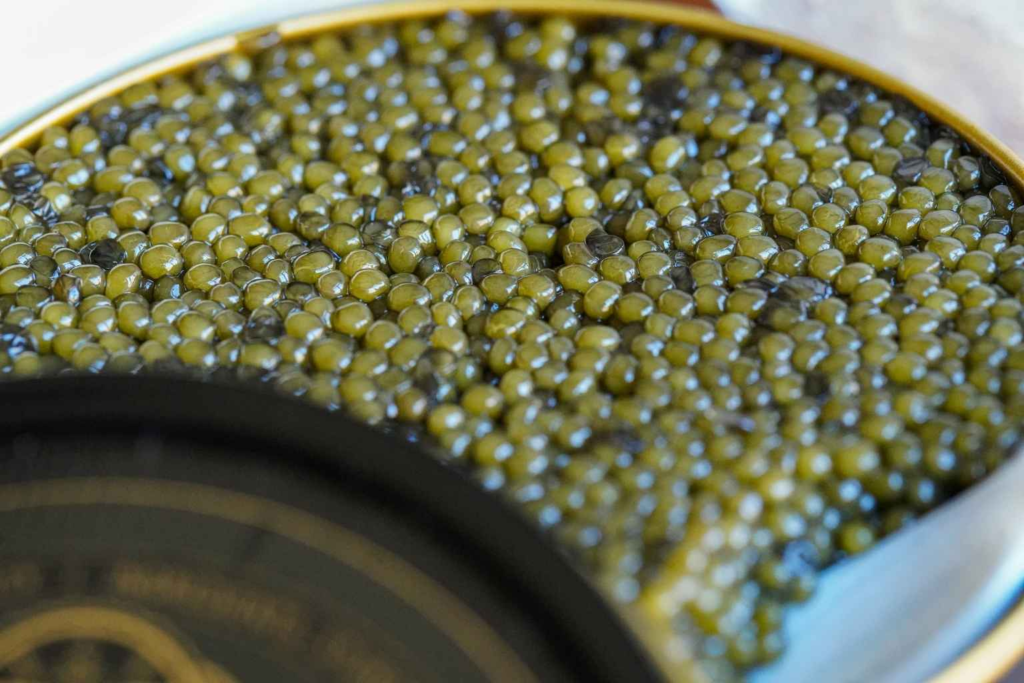
What Is Atlantic Sturgeon Caviar?
Atlantic sturgeon caviar is the salt-cured roe of the Atlantic sturgeon, an anadromous fish that spends part of its life in coastal or estuarine waters and returns to freshwater rivers to reproduce. Because Atlantic sturgeon belongs to the Acipenseridae family, its properly processed roe qualifies as true caviar.
This variety is much less common than farm-raised Siberian, white sturgeon, or hybrid caviar. Its limited availability reflects the species’ slow development, conservation status, restricted harvest, and the careful regulation of international sturgeon trade.
Atlantic Sturgeon Species and Characteristics
Atlantic sturgeon are large, long-lived fish native to the eastern coast of North America. Their natural range extends from Canadian waters south along the United States Atlantic coast. They are recognizable by their elongated bodies, rows of protective bony plates called scutes, and sensory barbels located beneath the snout.
The species moves among freshwater, estuarine, and marine environments during its life cycle. Young sturgeon develop in rivers and estuaries before moving into coastal waters. Mature fish later return to their natal river systems to spawn.
Atlantic sturgeon take many years to reach reproductive maturity, and adults may not spawn annually. These biological characteristics make depleted populations particularly slow to recover.
Is Atlantic Sturgeon Roe Real Caviar?
Yes. Traditional caviar is salt-cured roe obtained from fish in the sturgeon family. Since Atlantic sturgeon is a true sturgeon species, Atlantic sturgeon roe may correctly be labeled caviar.
However, the name alone does not confirm that a product is authentic, legal, or responsibly sourced. Buyers should verify the scientific species name, country of origin, production method, processing facility, and applicable CITES information.
Products described only as “Atlantic caviar” or “American caviar” may contain roe from another fish species. The label should identify Acipenser oxyrinchus oxyrinchus when the product is genuine Atlantic sturgeon caviar.
Flavor Profile and Texture of Atlantic Sturgeon Caviar
Atlantic sturgeon caviar is known for a rich, earthy flavor supported by savory depth and moderate marine salinity. It is generally more robust than delicate caviars characterized primarily by mild, buttery, or creamy notes.
The caviar’s medium texture provides enough firmness for a noticeable pop without becoming tough. Premium pearls should remain distinct and release their flavor gradually across the palate.
What Does Atlantic Sturgeon Caviar Taste Like?
Atlantic sturgeon caviar typically opens with clean brininess before developing deeper earthy and umami-rich flavors. Subtle mineral, nutty, or oceanic notes may emerge as the pearls dissolve.
Its finish is usually full-bodied and persistent. This stronger flavor profile may appeal to experienced caviar enthusiasts who prefer pronounced savory character over exceptionally mild roe.
Taste can vary according to the fish’s diet, environment, age, maturity, production method, and salt concentration. High-quality caviar should taste clean and balanced rather than aggressively salty or strongly fishy.
Pearl Size, Color, and Texture
Atlantic sturgeon caviar generally features medium-sized pearls with a medium firmness. The eggs should hold their shape when properly chilled and yield with a controlled pop against the tongue.
Colors may include:
- Charcoal gray
- Olive gray
- Dark brown
- Brown-black
- Nearly black
Natural color variation does not necessarily indicate a difference in quality. Pearl uniformity, membrane strength, freshness, aroma, flavor balance, and the number of broken eggs are usually more informative quality indicators.
Fresh caviar should appear glossy and well separated. Excessive liquid, flattened pearls, or a mushy consistency may suggest age, temperature fluctuations, or improper handling.

Origin, Habitat, and History
Atlantic sturgeon are native to river systems and coastal waters throughout eastern North America. Their range includes parts of Canada and the Atlantic coast of the United States, although the legal availability of caviar varies significantly between jurisdictions.
The species once supported a substantial commercial caviar industry. Heavy fishing pressure, combined with habitat degradation and other environmental threats, eventually caused severe population declines.
Atlantic Sturgeon in the USA and Canada
In the United States, Atlantic sturgeon populations are protected under the Endangered Species Act. The Gulf of Maine population is listed as threatened, while four other distinct U.S. population segments are listed as endangered. Buyers should not expect legitimate products to contain roe recently harvested from wild Atlantic sturgeon in U.S. waters.
Canadian Atlantic sturgeon populations are managed separately under Canadian conservation and fishery regulations. International exports of Atlantic sturgeon products from Canada require appropriate CITES authorization because the species is included in CITES Appendix II.
Regulations, authorized sources, and commercial availability may change. Consumers should therefore evaluate the documentation accompanying the individual product rather than assuming that any Atlantic sturgeon caviar labeled “Canadian” is automatically legal or sustainable.
Atlantic Sturgeon’s Role in Caviar History
Atlantic sturgeon played an important role in the rise of the American caviar trade during the nineteenth century. Rivers along the East Coast once produced large quantities of sturgeon roe for domestic markets and international export.
Commercial demand expanded faster than the species could reproduce. Overfishing contributed to dramatic population declines, while dams, declining water quality, habitat alteration, dredging, vessel strikes, and accidental bycatch created additional pressure.
This history makes Atlantic sturgeon an important example of why traceability and responsible production matter. Learn more about how caviar developed from an ancient delicacy into a global luxury product in our history of caviar guide.
Production and Responsible Sourcing
Atlantic sturgeon caviar must come from a legally authorized and fully traceable source. After mature roe is obtained, the eggs are carefully separated, rinsed, inspected, graded, salted, and packed under controlled conditions.
The finished product must remain consistently refrigerated throughout storage and distribution. Interruptions in the cold chain can damage the pearls’ texture, shorten shelf life, and compromise food safety.
How Atlantic Sturgeon Caviar Is Produced
Premium sturgeon roe is commonly prepared using a malossol-style cure. “Malossol” means “little salt” and describes an approach intended to preserve the caviar’s natural taste while adding sufficient salt for flavor and preservation.
Careful salting is particularly important for Atlantic sturgeon caviar because excessive salt can overwhelm its earthy and mineral characteristics. Quality also depends on the maturity of the eggs, sanitation, processing speed, pearl integrity, and storage temperature.
Producers may grade the finished caviar according to:
- Pearl size and consistency
- Color and visual uniformity
- Membrane firmness
- Separation of the eggs
- Aroma and flavor
- Salt balance
- Amount of broken roe or liquid
Terms such as “Grade 1,” “Royal,” or “Imperial” are not applied uniformly by every seller. Buyers should examine the actual product specifications instead of relying on a premium-sounding grade name alone.
Conservation, Legality, and Traceability
Atlantic sturgeon populations remain vulnerable because the fish grow slowly and require many years to reproduce. Responsible sourcing begins with confirming that the roe was obtained through an authorized fishery or regulated aquaculture operation.
For internationally traded sturgeon caviar, CITES labeling helps identify the species, source, country of origin, production or processing facility, and year of harvest or processing. The species code associated with Atlantic sturgeon should correspond to Acipenser oxyrinchus.
Before purchasing, look for:
- Scientific species identification
- Country of origin
- Wild or aquaculture source
- Producer or processing facility
- CITES labeling when applicable
- Packing or best-before information
- Refrigerated shipping procedures
- Clear storage instructions
Avoid sellers that make vague claims about “wild American Atlantic sturgeon caviar” without verifiable legal documentation. Learn more about slow maturation and reproduction in our guide to sturgeon biology for caviar.
How to Serve and Pair Atlantic Sturgeon Caviar
Serve Atlantic sturgeon caviar thoroughly chilled so the pearls retain their shape and the rich flavor remains clean and balanced. Keep the tin refrigerated until shortly before serving, then place it over a bed of crushed ice.
Its earthy intensity pairs best with simple accompaniments and dry, palate-cleansing drinks. Strong sauces, excessive citrus, or heavily seasoned garnishes can conceal the qualities that make the caviar distinctive.
Best Ways to Serve Atlantic Sturgeon Caviar
Taste a small spoonful of Atlantic sturgeon caviar on its own before adding accompaniments. This makes it easier to evaluate the pearl texture, salt balance, flavor development, and finish.
Suitable accompaniments include:
- Plain blinis
- Unsalted toast points
- Crème fraîche
- Warm new potatoes
- Soft-cooked eggs
- Mild, unsalted potato chips
Use a mother-of-pearl, horn, glass, or other nonreactive caviar spoon. Reactive metal utensils can introduce an undesirable metallic impression.
For a tasting, allow approximately 15 to 30 grams per guest. A more generous serving in which caviar is the main attraction may require approximately 30 to 50 grams per person.
Champagne and Vodka Pairings
Dry Champagne provides acidity and effervescence that balance Atlantic sturgeon caviar’s rich, earthy character. Brut, Extra Brut, and Blanc de Blancs styles are suitable choices because they refresh the palate without adding excessive sweetness.
Chilled vodka offers a cleaner and more neutral pairing. Its restrained flavor resets the palate between bites while allowing the caviar’s savory and mineral notes to remain prominent.
Serve either drink well chilled. Avoid sweet sparkling wine, flavored vodka, or strongly oaked beverages that could compete with the caviar’s natural flavor.

Frequently Asked Questions About Atlantic Sturgeon Caviar
Atlantic sturgeon caviar is a rare premium caviar produced from the salt-cured roe of Acipenser oxyrinchus oxyrinchus, a species native to Atlantic rivers and coastal waters in the United States and Canada. It is known for its rich, savory character, moderate brininess, and earthy, mineral, or subtly nutty notes that may linger on the palate. Because wild Atlantic sturgeon populations in the United States are protected, commercial caviar must come from legally authorized, fully documented sources with clear origin and traceability information. Its luxury status reflects the sturgeon’s slow maturation, limited production, conservation controls, careful grading, specialized processing, and refrigerated distribution.
What is Atlantic sturgeon caviar?
Atlantic sturgeon caviar is the salt-cured roe of Acipenser oxyrinchus oxyrinchus, a true sturgeon species native to Atlantic rivers and coastal waters in the United States and Canada. Because Atlantic sturgeon belongs to the Acipenseridae family, its properly processed roe qualifies as authentic caviar. It should not be confused with non-sturgeon fish roe.
What does Atlantic sturgeon caviar taste like?
Atlantic sturgeon caviar is generally associated with a rich, earthy, and savory flavor accompanied by moderate brininess. Depending on the producer, processing method, and individual product, it may also reveal mineral, nutty, or oceanic notes with a lingering finish. Flavor and texture can vary, so the species name alone does not guarantee a particular tasting experience.
Where does Atlantic sturgeon caviar come from?
Atlantic sturgeon is native to rivers and coastal waters along the Atlantic regions of the United States and Canada. Because wild U.S. populations are federally protected, commercial products must come from legally authorized and documented sources rather than protected wild harvests. Buyers should review the stated country of origin, production method, and traceability information.
Is Atlantic sturgeon caviar legal in the United States?
Legally sourced and properly documented Atlantic sturgeon caviar may be sold in the United States, but legality depends on its source and compliance with applicable conservation and trade requirements. Wild Atlantic sturgeon populations in the United States are protected, making origin and documentation especially important. Buyers should choose sellers that clearly disclose how and where the product was produced.
Why is Atlantic sturgeon caviar rare and expensive?
Atlantic sturgeon matures slowly, and its wild populations have been affected by historical overfishing, habitat loss, and other environmental pressures. Conservation protections and limited authorized production restrict commercial availability compared with widely farmed varieties. Its price may also reflect the long production timeline, specialized processing, grading, documentation, and refrigerated distribution.
What color is Atlantic sturgeon caviar, and what pairs well with it?
Atlantic sturgeon caviar pearls may appear charcoal gray, olive gray, dark brown, brown-black, or nearly black. Color varies naturally and should be evaluated alongside pearl condition, aroma, texture, and flavor rather than treated as an independent measure of quality. Traditional accompaniments include plain blinis, crème fraîche, warm potatoes, toast points, and lightly salted potato chips, while dry Champagne and chilled vodka are common beverage pairings.
How can buyers verify and store Atlantic sturgeon caviar?
Check the label for the scientific name Acipenser oxyrinchus oxyrinchus, country of origin, source type, producer or packer, lot or packing information, and any applicable traceability or CITES labeling. Purchase from a reputable seller that can clearly explain the product’s legal source, production method, shipping process, and storage requirements. Keep the unopened container refrigerated according to the producer’s directions; after opening, keep it properly chilled and consume it within the seller’s recommended period.
Experience Atlantic Sturgeon Caviar
Atlantic sturgeon caviar represents an important part of North American culinary history. Its medium-textured pearls, rich earthy flavor, savory depth, and persistent mineral finish distinguish it from milder and more widely available sturgeon caviars.
Its rarity also makes responsible purchasing essential. Authenticity should be supported by clear species identification, legal sourcing, traceability, and careful cold-chain handling. When properly documented and served, Atlantic sturgeon caviar offers a distinctive tasting experience while illustrating the close connection between caviar appreciation and sturgeon conservation.