What Is Siberian × Russian Hybrid Caviar?
Siberian × Russian hybrid caviar is the salt-cured roe of a cultivated cross between Siberian and Russian sturgeon. Because both parent fish belong to the sturgeon family, Acipenseridae, the resulting roe qualifies as true caviar rather than a non-sturgeon roe substitute.
The hybrid is selectively raised in aquaculture systems designed to manage water quality, nutrition, fish health, and maturation. Producers may use hybridization to combine useful farming characteristics while developing roe with a distinct balance of flavor, pearl size, and membrane firmness.
The exact experience can vary between farms and batches. Genetics, the direction of the cross, water conditions, feed, the age and maturity of the female, salt concentration, and maturation after packing can all influence the finished caviar.
Siberian and Russian Sturgeon Parentage
The Siberian sturgeon, Acipenser baerii, is widely used in European caviar farming because it adapts effectively to controlled aquaculture environments. Its caviar is generally known for dark pearls, moderate brininess, and a smooth flavor that may include creamy, earthy, or lightly mineral notes.
Russian sturgeon, Acipenser gueldenstaedtii, is traditionally associated with Ossetra-style caviar. Its roe is prized for firm pearls and layered flavors that can include nuts, butter, minerals, and the sea.
Crossing these two sturgeons does not simply create an equal sensory blend in every tin. Individual hybrids may express different proportions of their parent characteristics. Nevertheless, carefully produced examples often combine Siberian caviar’s accessibility with the structured texture and nutty depth associated with Russian sturgeon.
Is Hybrid Sturgeon Roe Real Caviar?
Yes. Caviar is salt-cured roe from fish belonging to the sturgeon family. Since both parents of this hybrid are sturgeon, Siberian × Russian hybrid roe is authentic caviar.
“Hybrid” describes the fish’s parentage; it does not indicate that the roe is artificial, blended after harvesting, or inferior. The eggs develop naturally in a hybrid female sturgeon and are harvested, graded, salted, and packed using the same core methods applied to other farmed caviar.
Buyers should still check the product label carefully. “Hybrid caviar” can refer to several different sturgeon crosses, so the parent species should be identified whenever possible. A product described as Siberian × Russian hybrid caviar should list A. baerii × A. gueldenstaedtii rather than relying on a vague premium name.
Flavor Profile and Texture of Siberian × Russian Hybrid Caviar
Siberian × Russian hybrid caviar typically has a creamy, nutty flavor with moderate salinity and a clean savory foundation. Its character is generally richer than basic Siberian caviar but may be more approachable and less intensely complex than mature Russian sturgeon caviar.
The flavor usually develops in stages. A mild marine opening gives way to cream, toasted nuts, and restrained umami, followed by a clean finish that may contain subtle mineral, buttery, or earthy notes.
Its medium-firm texture is an important part of the experience. The pearls retain their shape on a spoon or canapé, then release their flavor with a defined but tender pop.
What Does Siberian × Russian Hybrid Caviar Taste Like?
High-quality Siberian × Russian hybrid caviar should taste balanced rather than sharply salty or overtly fishy. The first impression is often clean and lightly briny, followed by creamy richness and a distinct nutty character.
Depending on the producer and batch, secondary notes may include:
- Fresh butter
- Toasted hazelnut or almond
- Mild ocean salinity
- Clean minerals
- Subtle earthiness
- A restrained savory finish
The Russian sturgeon lineage can contribute structure and nutty complexity, while the Siberian side may provide a smooth, direct flavor. This balance makes the caviar suitable for first-time buyers as well as experienced diners seeking an adaptable premium variety.
Taste is not determined by genetics alone. Feed composition, water quality, egg maturity, curing technique, salt percentage, and storage time can produce meaningful differences between two tins carrying the same hybrid designation.
Pearl Size, Color, and Medium-Firm Texture
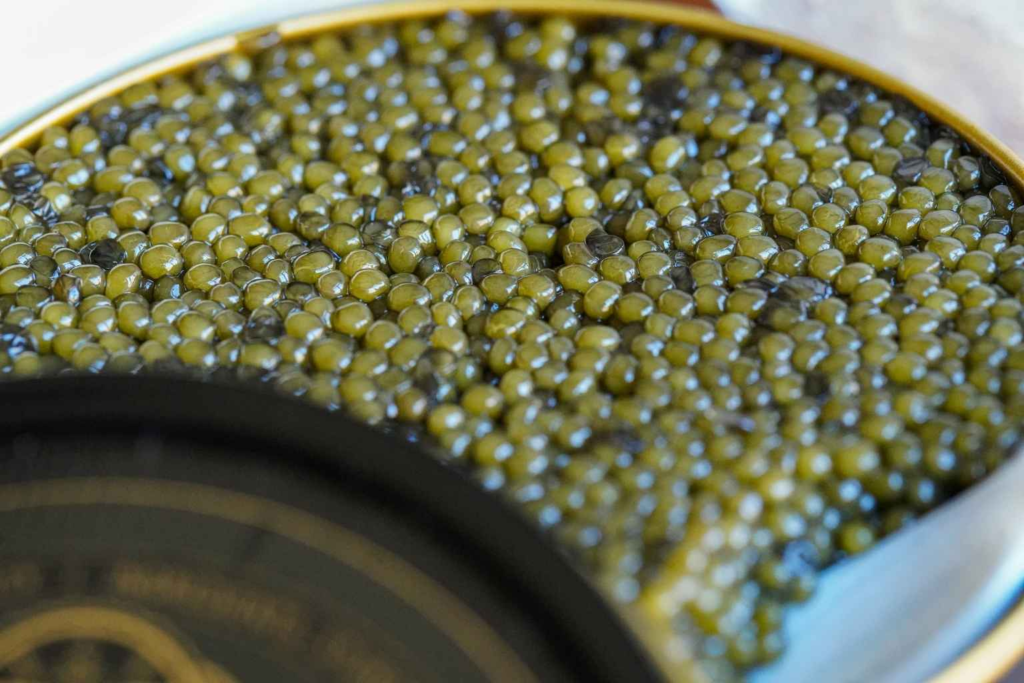
The pearls are generally medium in size and commonly range from approximately 2.5 to 3.2 millimeters. Natural colors may include dark gray, slate, charcoal, olive gray, brown-gray, or nearly black. Some batches may show lighter silver or warm amber undertones.
Premium pearls should be glossy, intact, and reasonably uniform, with little excess liquid. When pressed gently against the palate, the membrane should provide a noticeable pop before releasing the creamy interior.
Medium-firm does not mean hard or rubbery. A tough membrane may indicate that the eggs were collected at an unsuitable stage of maturity, while soft or flattened eggs can result from age, rough handling, or temperature fluctuations. Pearl integrity, aroma, salt balance, and flavor cleanliness are more reliable quality indicators than color alone.

Origin and European Aquaculture
Siberian × Russian hybrid caviar is principally an aquaculture product. France and Italy have established sturgeon-farming sectors with the water-management systems, hatchery expertise, processing facilities, and refrigerated distribution networks required for premium caviar production.
Neither parent species is native to France or Italy. Their association with these countries comes from controlled farming rather than wild harvest. The fish are raised in managed systems where producers can monitor water quality, nutrition, stocking density, development, and reproductive maturity.
A European origin does not automatically establish superior quality. The individual farm’s husbandry, environmental controls, processing standards, transparency, and cold-chain practices remain more important than country prestige alone.
Production in France and Italy
France has a long modern history of cultivating Siberian sturgeon, while Italy has become one of Europe’s significant farmed-caviar producers. This experience provides a technical foundation for raising pure species and selected hybrid sturgeon.
Depending on the farm, fish may be raised in flow-through raceways, spring-fed systems, ponds, tanks, or recirculating aquaculture systems. Each method has different implications for water use, energy consumption, temperature control, waste management, and fish density.
Producers monitor the females as they mature, often using ultrasound or other noninvasive assessments to evaluate gonadal development. Roe must be harvested at the correct stage: immature eggs may lack proper size and flavor, while overly mature eggs can lose the membrane strength needed for premium caviar.
Consumers should confirm the actual country and farm shown on the container. A company based in France or Italy may sell caviar raised or processed elsewhere, so the brand’s address alone does not prove the roe’s production origin.
Why Sturgeon Are Hybridized in Aquaculture
Hybridization may be used to combine traits such as adaptability, growth performance, disease resilience, reproductive development, and product consistency. From a caviar perspective, breeders may also seek desirable pearl size, color, texture, yield, or flavor.
A hybrid should not be judged as automatically better or worse than a pure-species sturgeon. Quality depends on whether the cross is responsibly managed and whether the resulting roe is harvested and processed to a high standard.
Hybridization also requires accurate recordkeeping. Farms must maintain reliable broodstock records, and sellers should avoid marketing hybrid roe as pure Siberian, Russian, or Ossetra caviar. Transparent parentage allows buyers to compare products accurately and prevents premium species terms from being used misleadingly.
Production, Quality, and Responsible Sourcing
Producing Siberian × Russian hybrid caviar requires several years of controlled fish husbandry before a female reaches suitable maturity. During that period, the farm must manage water conditions, nutrition, health, space, and animal welfare while identifying and monitoring roe-producing females.
After harvesting, the eggs are separated from surrounding tissue, rinsed, inspected, graded, and salted. The caviar is then packed and maintained under continuous refrigeration. Small changes in handling speed, salt level, and storage conditions can substantially affect flavor and texture.
Its mid-luxury $$$ price band reflects the time required to raise mature sturgeon, the specialized infrastructure involved, limited roe yield, skilled processing, packaging, and refrigerated transportation.
Malossol Curing and Quality Grading
Siberian × Russian hybrid caviar is commonly prepared using a malossol-style cure. “Malossol” means “little salt” and generally refers to caviar cured with a relatively restrained amount of salt so the roe’s natural flavor remains prominent.
The term is descriptive rather than a universal guarantee of one precise salt percentage. Buyers should not assume that every product labeled malossol contains exactly the same amount of salt.
Producers may evaluate the finished caviar according to:
- Pearl size and uniformity
- Membrane strength
- Color and visual consistency
- Separation of the eggs
- Cleanliness of aroma
- Flavor complexity
- Salt balance
- Amount of broken roe or liquid
Grade 1 usually indicates more uniform pearls, firmer membranes, and stronger sensory consistency, while Grade 2 may contain greater variation in size, color, or texture. However, caviar grading is not globally standardized. Terms such as “Royal,” “Imperial,” and “Reserve” may be defined differently by each seller.
Sustainability, Traceability, and CITES
Farmed hybrid caviar can reduce commercial pressure on endangered wild sturgeon populations, but aquaculture is not automatically sustainable. Its environmental performance depends on water sourcing, energy use, feed, effluent treatment, stocking density, animal health, escape prevention, and waste management.
Responsible farms should accurately document both parent species and prevent cultivated, non-native sturgeon from entering surrounding ecosystems. This is particularly important in France and Italy, where Siberian and Russian sturgeon are not native species.
International trade in sturgeon and sturgeon products is regulated under CITES. Retail containers should carry appropriate labeling that helps identify the source, origin, and processing or repackaging operation. Because hybrid codes and labeling can be more complex than single-species identification, buyers should choose sellers capable of explaining the product’s parentage and traceability.
For a broader explanation of aquaculture and conservation, read our guide to sustainable caviar and conservation.
How to Serve, Pair, and Buy Hybrid Caviar
Siberian × Russian hybrid caviar should be served very cold, ideally at approximately 28–32°F (-2–0°C), without being frozen. Keep the sealed tin refrigerated according to the producer’s instructions and open it shortly before serving.
Present the container over crushed ice and use a mother-of-pearl, horn, glass, ceramic, or other nonreactive spoon. Taste the caviar by itself first so its salt balance, texture, creaminess, and nutty finish can be evaluated without interference.
Its versatile flavor works equally well in a focused tasting or as part of an elegant appetizer. Neutral accompaniments provide contrast while allowing the caviar to remain the central flavor.
Best Ways to Serve Siberian × Russian Hybrid Caviar
Traditional accompaniments such as plain blinis, lightly toasted bread, warm new potatoes, and crème fraîche complement the caviar’s creamy profile. Unsalted potato chips can add crisp contrast without introducing a competing flavor.
Avoid heavily seasoned garnishes, aggressive citrus, strongly flavored onions, or sweet sauces. These can obscure the subtle transition from clean salinity to cream and nuts.
For a tasting or appetizer, plan approximately 15–30 grams per guest. If the caviar is the primary focus, 30–50 grams per person creates a more generous experience.
Once opened, the caviar should remain cold and be consumed within the producer’s recommended period. Do not return caviar to the tin after it has been left at room temperature for an extended time.
Champagne and Vodka Pairings
Dry Champagne is an especially effective pairing because its acidity and bubbles cut through the caviar’s creamy richness. Brut, Extra Brut, or mineral-driven Blanc de Blancs styles can refresh the palate while complementing its restrained salinity.
Chilled vodka creates a cleaner and more neutral pairing. A high-quality unflavored vodka resets the palate between spoonfuls without masking the caviar’s nutty, buttery, or mineral notes.
When buying Siberian × Russian hybrid caviar, examine more than the marketing name. Confirm:
- Both parent species
- Country of aquaculture
- Producer or farm
- Packing or repacking facility
- CITES or traceability information
- Packing and best-before dates
- Refrigerated shipping method
- Storage instructions
The scientific identity should correspond to Acipenser baerii × Acipenser gueldenstaedtii. If the seller merely calls the product “hybrid caviar,” ask which species were crossed. Learn how hybrid products differ from pure-species roe in our hybrid caviar guide.

Frequently Asked Questions About Siberian × Russian Hybrid Caviar
Siberian × Russian Hybrid Caviar is a premium farm-raised caviar produced from a cross between Siberian sturgeon (Acipenser baerii) and Russian sturgeon (Acipenser gueldenstaedtii). It is known for its balanced savory character, moderate brininess, firm pearls, and buttery, nutty, or subtly mineral notes that may linger on the palate. Responsible aquaculture production can provide greater consistency, traceability, and availability than caviar sourced from protected wild sturgeon populations. Its premium status reflects the sturgeon’s maturation period, controlled farming conditions, careful grading, traditional Malossol processing, and refrigerated distribution.
What is Siberian × Russian Hybrid Caviar?
Siberian × Russian Hybrid Caviar is salt-cured roe from a farm-raised cross between Siberian sturgeon (Acipenser baerii) and Russian sturgeon (Acipenser gueldenstaedtii). Because both parent species belong to the sturgeon family, the hybrid’s roe qualifies as authentic caviar. It is generally recognized for its creamy, nutty flavor and medium-firm pearls.
What does Siberian × Russian Hybrid Caviar taste like?
This hybrid caviar commonly has a clean, moderately briny opening followed by buttery, creamy, nutty, and lightly mineral notes. Its medium-firm pearls typically provide a defined but tender pop and a smooth finish. The exact flavor and texture can vary according to the farm, feed, water quality, egg maturity, salting method, grading, and individual batch.
Is hybrid caviar genetically modified?
No, conventional sturgeon hybridization does not mean the fish has been genetically engineered. It involves breeding two compatible sturgeon species—in this case, Siberian and Russian sturgeon—to combine selected aquaculture and caviar characteristics. Buyers can confirm the hybrid identity by reviewing the species information and traceability code on the container.
Is Siberian × Russian Hybrid Caviar the same as Ossetra?
No. Traditional Ossetra caviar comes from Russian sturgeon, Acipenser gueldenstaedtii, while this hybrid has genetic contributions from both A. gueldenstaedtii and A. baerii. Although sellers may use terms such as “hybrid Ossetra,” the label should disclose both parent species rather than presenting the product as pure Russian sturgeon caviar.
Why does Siberian × Russian Hybrid Caviar cost less than some pure Russian sturgeon caviar?
Hybrid sturgeon may offer more efficient aquaculture performance and broader availability than pure Russian sturgeon, which can result in a lower retail price. However, the final cost still depends on maturation time, production country, pearl size, color, texture, grade, brand, packaging, and supply. A lower price does not automatically indicate lower quality.
How should Siberian × Russian Hybrid Caviar be served?
Serve the caviar properly chilled in its original tin or container placed securely over crushed ice. Use a clean, nonreactive spoon and taste it plain before adding mild accompaniments such as blinis, crème fraîche, warm potatoes, toast points, or eggs. Dry Champagne and chilled, unflavored vodka pair well with its creamy, nutty, and moderately briny profile.
How can buyers verify responsibly produced Siberian × Russian Hybrid Caviar?
Look for both parent species, the production country, aquaculture source code, producer or processor details, lot information, and applicable CITES labeling. Hybrid caviar can be a responsible alternative to wild-sourced roe when it comes from a transparent, well-managed aquaculture operation. Sustainability should be assessed through traceability, water and feed management, effluent controls, fish welfare, energy use, and escape-prevention practices rather than hybrid status alone.
Experience Siberian × Russian Hybrid Caviar
Siberian × Russian hybrid caviar offers a refined middle ground between two influential farmed-sturgeon traditions. Its creamy body, nutty complexity, medium-firm pearls, and controlled salinity make it accessible enough for newer caviar buyers while retaining the depth sought by experienced enthusiasts.
The best examples are not defined by the word “hybrid” alone. They reflect responsible husbandry, accurate parentage, mature roe, careful malossol curing, transparent labeling, and an uninterrupted cold chain. When properly sourced and served, this French- and Italian-associated hybrid can provide a sophisticated premium experience at a more approachable price than many rare pure-species caviars.